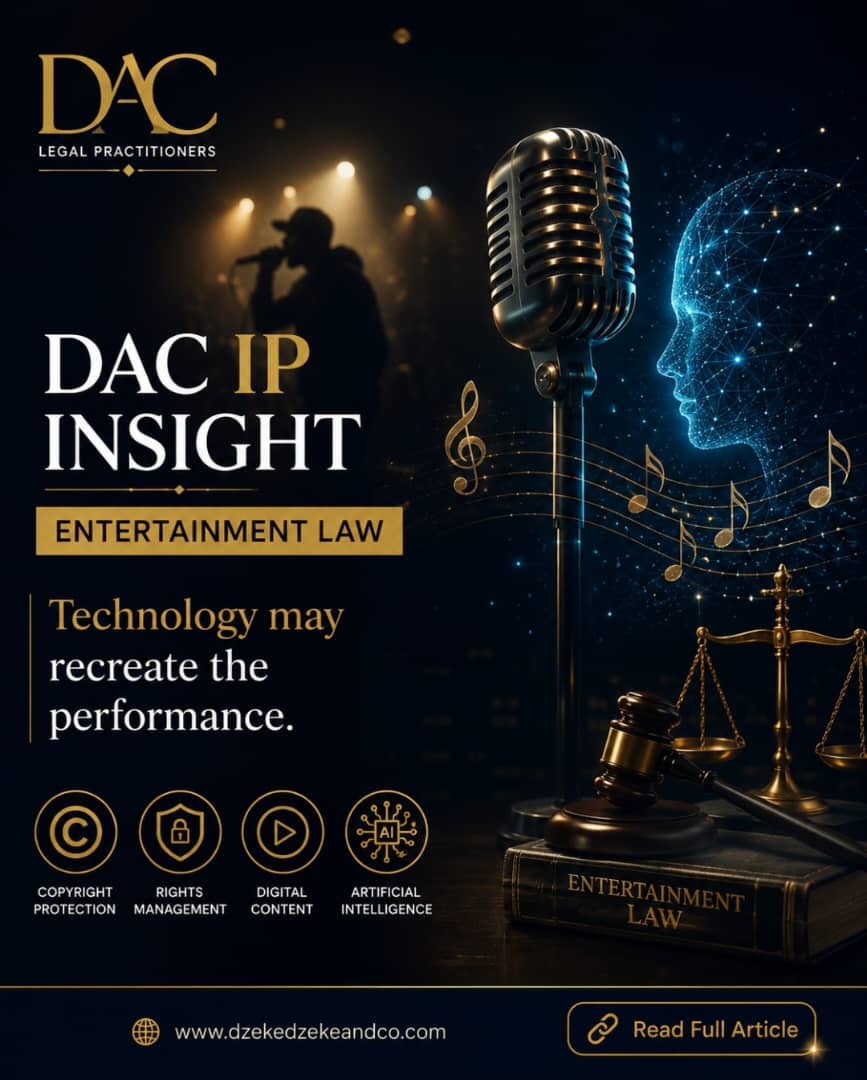
DAC IP INSIGHT
The entertainment industry has undergone a remarkable transformation over the past two decades. Music, films, podcasts and other creative works can now reach global audiences almost instantly through digital platforms.
Yet perhaps the most fascinating development is not simply how content is distributed, but how technology is changing the very nature of entertainment itself.
At Dzekedzeke and Company, one Advocate is a lifelong admirer of Tupac Shakur. Through modern artificial intelligence technology, he can now sit and watch what appear to be brand-new Tupac music videos and performances, almost as though Tupac has just walked into a recording studio, recorded a new song and released a new video.
The experience can be astonishing.
The face looks like Tupac. The voice sounds like Tupac. The movements resemble Tupac. To the viewer, it can feel as though one of the most influential artists in hip-hop history is still actively producing new content today.
Yet the reality is very different.
Tupac passed away in 1996. The videos, performances and songs that appear to be new are often the result of artificial intelligence, digital recreation technologies, archived recordings and sophisticated editing techniques.
This remarkable development raises important legal questions.
Who owns a deceased artist’s image?
Who controls the use of their voice?
Can artificial intelligence be used to generate new performances featuring an artist who is no longer alive?
Who is entitled to royalties generated from such content?
Can technology recreate a performer, or does it merely imitate them?
These questions fall within the growing field of entertainment law, which governs the relationships between artists, performers, production companies, broadcasters, streaming platforms and audiences.
As technology advances, entertainment law increasingly intersects with copyright law, image rights, personality rights, contracts, licensing agreements and intellectual property protection. The legal issues are no longer limited to protecting songs and films. They now extend to protecting identities, voices, digital personas and creative legacies.
The challenge facing lawmakers is significant. Technology now makes it possible to recreate voices, generate realistic performances and produce content that appears authentic even when the artist is no longer alive. While these developments create exciting opportunities for entertainment and historical preservation, they also raise concerns about ownership, consent, compensation and authenticity.
As Africa’s creative industries continue to grow, robust legal frameworks will become increasingly important in ensuring that creators and their families receive fair recognition and compensation for their contributions.
The digital age has demonstrated that an artist’s influence can survive long after their lifetime. Artificial intelligence may enable future generations to experience performances in ways previously unimaginable, but the law must ensure that innovation remains balanced with fairness, respect and the protection of creative rights.
Technology may recreate the performance.
But the law must protect the legacy.
For legal advice on entertainment law, copyright and intellectual property, contact Dzekedzeke and Company.
Website: www.dzekedzekeandco.com